 FORS Gold & ISO 9001 Certified
Accreditations Decoded
Every supplier form asks for them. Every tender scores them. And every supplier’s website has a row of little logos along the bottom, like stickers on a toolbox.
But ask what FORS Gold actually checks, and you’ll usually get a confident nod and a quick change of subject. So here’s the plain-English version: what each one covers, what it doesn’t, and how to tell a real certificate from a nice-looking image of one.
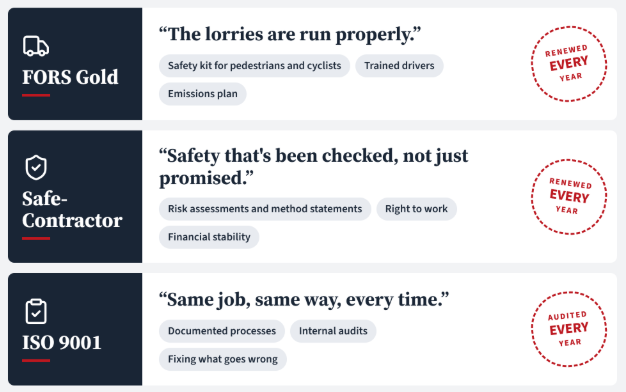
The short answer: FORS Gold checks how the lorries are run, SafeContractor checks health and safety, and ISO 9001 checks that the business does things the same way every time. None of them checks everything, so it pays to know which does what.
The 30-second version
For anyone reading this between site meetings.
|
|
FORS Gold | SafeContractor | ISO 9001 |
|
In one line |
The lorries are run properly |
Safety that’s been checked, not just promised |
Same job, same way, every time |
|
What it checks |
How a fleet of vehicles and drivers is run |
Health and safety, plus legal and ethical practices |
How the business manages quality |
|
Who runs it |
The Fleet Operator Recognition Scheme |
SafeContractor, an SSIP member scheme |
Independent certification bodies, against an international standard |
| How often | Renewed every year | Renewed every year |
Audited at least yearly, on a three-year cycle |
FORS Gold: the lorries are run properly
FORS is the Fleet Operator Recognition Scheme. It has three levels: Bronze, Silver and Gold. It’s a bit like an Olympic podium, but for fleet management and you have to pass Bronze and Silver before achieving Gold.
What the levels cover:
- Bronze: the legal basics, written policies and procedures, and training for drivers and managers.
- Silver: safety kit on vehicles to protect pedestrians and cyclists, monitoring of fuel, emissions and collisions, support for CLOCS (construction’s road safety standard), and holding subcontractors to the same standards.
- Gold: all of that, plus a written plan to cut emissions, proof of improvement year on year, a staff development plan, and the same standards at every site and with every subcontractor.
Why it matters to you: on a busy site or a city street, the biggest thing moving near people on foot or on bikes is usually the delivery lorry. FORS Gold means someone has checked the vehicles, the drivers and how deliveries are planned, not just that the lorry turned up. It also only lasts 12 months, so nobody gets to frame the certificate and forget about it.
SafeContractor: safety that’s been checked, not just promised
SafeContractor assesses a contractor’s health and safety against core criteria approved by the Health and Safety Executive (HSE). It’s a member of SSIP (Safety Schemes in Procurement), so its certificate is recognised by every other SSIP scheme. In practice, that means one assessment counts across all of them, instead of a supplier answering the same questions over and over until they lose the will to live.
What it checks:
- Health and safety policies, plus risk assessments and method statements (RAMS): the documents that set out how each job will be done safely.
- Higher-risk activities where they apply, such as working at height or handling hazardous materials.
- Wider legal and ethical areas: right to work, equality, financial stability, anti-bribery and modern slavery.
Why it matters to you: someone independent has already been through the health and safety paperwork you’d otherwise have to chase. It’s reassessed every year, so it can’t quietly go out of date in a drawer.
ISO 9001: same job, same way, every time
ISO 9001 is the international standard for quality management, and the most widely used one in the world. ISO reports more than a million certificates in 189 countries. That’s a lot of businesses working to the same rulebook.
What it checks:
- That the business has defined, documented processes for how it delivers its work.
- That the people in charge take responsibility for quality and plan for risks.
- That performance is measured, with regular internal audits and management reviews.
- That problems get fixed and the business keeps improving.
Certification is carried out by independent certification bodies, not by ISO itself. Certificates run on a three-year cycle, with audits at least once a year.
Why it matters to you: ISO 9001 doesn’t mean a supplier never gets anything wrong. It means that when something does go wrong, there’s a process for finding out why and stopping it happening again, rather than a shrug and “we’ve always done it like that”.
What to check alongside them
Together, these three give a strong picture of a supplier, but they’re not a force field. Here’s what’s worth checking separately:
- How a product performs. A crash-tested barrier is tested against its own standards. ISO 9001 covers how the barrier is made and delivered, not what happens when a van hits it.
- Ask for current insurance certificates and check the cover against your contract.
- Environmental management. That’s ISO 14001, a different standard with its own logo for the bottom of the website.
- Your site’s own rules. Inductions, permits and delivery slots are still sorted job by job. No accreditation gets a lorry through your gate at 7:20 if its slot was 7:00.
- Relevant experience. Accreditations show how a business is run, not whether it has done a job like yours. Ask for case studies or references.
How to check a supplier’s accreditations
- Ask for the current certificate. A logo on a website is just a picture, and anyone can download a picture. Check the expiry date, as FORS Gold and SafeContractor both renew every year.
- Check the scope. An ISO 9001 certificate states which activities it covers. Make sure that includes the work you’re buying.
- Check the issuer. For ISO 9001, the certification body should be accredited by UKAS. For FORS and SafeContractor, confirm the accreditation is current with the scheme.
Maltaward’s accreditations
Maltaward holds FORS Gold, SafeContractor and ISO 9001, alongside Constructionline Gold and CHAS. We’re also certified to the Common Assessment Standard, Build UK’s pre-qualification standard for construction, which government guidance now recommends for public-sector contracts. If you’re adding us to an approved supplier list, or wrestling with a tender portal at 4pm on a Friday, ask for our current certificates and we’ll send them over. Real ones, with dates on.
Frequently Asked Questions
What does FORS Gold mean?
FORS Gold is the top level of the Fleet Operator Recognition Scheme. To reach it, an operator must already hold Bronze and Silver, then show a written plan to cut emissions, year-on-year improvement in fleet performance and a staff development plan. It’s renewed every year.
Is SafeContractor the same as CHAS?
They’re separate schemes, but both assess health and safety against the same core criteria approved by the HSE. Both are members of SSIP (Safety Schemes in Procurement), so each recognises the other’s certificate.
Does ISO 9001 mean a product is good quality?
Not on its own. ISO 9001 certifies how a business manages quality: its processes, audits and how it fixes problems. Product performance, such as a barrier’s crash rating, is tested against separate standards.
How long does ISO 9001 certification last?
ISO 9001 certificates run on a three-year cycle, with audits by the certification body at least once a year.
How do I check a supplier’s accreditation is valid?
Ask for the current certificate and check the expiry date. For ISO 9001, check the scope covers the work you’re buying and that the certification body is accredited by UKAS. For FORS and SafeContractor, confirm with the scheme that the accreditation is current.
What is the Common Assessment Standard?
The Common Assessment Standard is Build UK’s pre-qualification standard for construction suppliers. Government procurement guidance recommends it, or an equivalent, for public-sector construction contracts.
Which accreditations does Maltaward hold?
Maltaward holds FORS Gold, SafeContractor, ISO 9001, Constructionline Gold and CHAS, and is certified to the Common Assessment Standard.