
 FORS Gold & ISO 9001 Certified
 Understanding Fire Resistance of Concrete Barriers
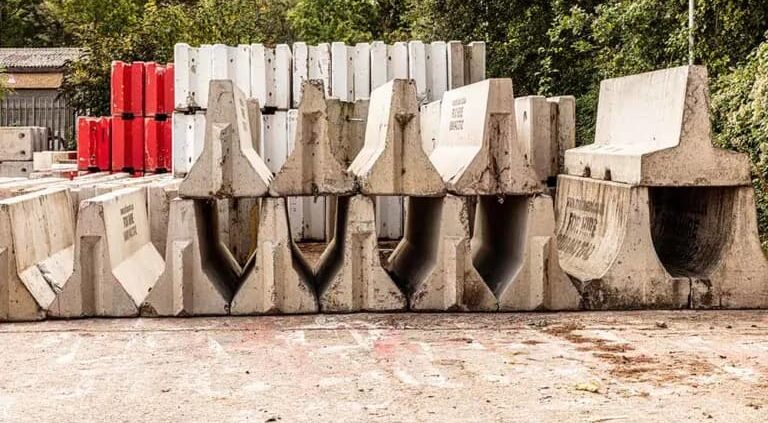
When safeguarding construction sites, industrial facilities, and public spaces, fire safety is one thing that never should be overlooked. Site managers often focus on active fire protection systems like alarms, sprinklers, and fire exit doors and escape routes, but the materials used for perimeter security and site segregation play an equally vital role.
Many of these security products are made from concrete, and understanding its fire resistance properties can help you make informed decisions that protect your premises, and the people that pass through it every day.
What Makes Concrete Fire-Resistant?
Concrete’s exceptional fire resistance stems from three key properties:
- Non-combustible composition: The aggregates and cement forming concrete’s structure cannot be set alight
- Low thermal conductivity: Heat doesn’t transfer readily through concrete, creating an effective thermal barrier
- No toxic emissions: Unlike many materials, concrete releases no harmful gases when exposed to naked flames and high temperatures
Internal temperatures within concrete rise slowly, even under intense heat. This helps maintain structural integrity far longer than materials like timber or even steel.
Fire Rating Classifications Explained
The UK measures fire resistance (either how it can resist it or protect against it) using European Standard BS EN 13501-1:2018, determined by the European Commission. This classifies materials from A1 (highest) to F (failed/untested):
- A1: Materials do not contribute to fire at any stage and no further classification needed. For clarity, concrete is rated A1.
- A2: Materials resist and don’t contribute to a fire but may produce some smoke or flaming droplets.
- B: Material is highly resistant but further classification for smoke and flame byproducts needed.
- C: These materials show progressively lower fire resistance and limited contribution towards it.
- D: A material can contribute to a fire, but is more resistant than categories below it.
- E: A material contributes more significantly to fire spread but can resist flame exposure for a short time.
- F: Reserved for untested or failed products
Concrete blocks achieve the A1 classification under BS EN 13501-1:2018, making them completely non-combustible and suitable for the most demanding fire safety applications.
Fire Protection on Construction Sites
Construction sites face unique fire risks, influenced largely by the proximity to heat sources, the combustible nature of building materials like timber or plasterboard, and more. Temporary structures, flammable materials, prolonged exposure to high temperatures, and electrical faults (among others) create environments where fire can spread rapidly.
Concrete barriers become essential components of a comprehensive fire safety strategy for a building, and even if they’re only used temporarily to guide pedestrians or vehicles safely to and from a site, they can offer superb fire resistance.
Concrete barrier blocks serve multiple protective functions:
- Create physical compartmentation, dividing sites into zones that contain fire spread
- Protect escape routes, preventing flames from blocking evacuation paths
- Shield high-risk areas like fuel storage or welding zones from the rest of the site
- Maintain position during fire incidents due to substantial weight
Approved Document B of the Building Regulations stipulates fire resistance periods for fire break walls, typically 60 or 120 minutes depending on building type.
How Resistant Are Barriers?
Fire resistance depends on several factors:
- Thickness: Most concrete blocks with a thickness level of 100mm or over provide at least 2 hours of solid fire protection. Blocks of 140mm and above can exceed 3 hours.
- Aggregates: Carbonate aggregates, particularly dolomite, demonstrate superior strength when exposed to fire.
- Moisture content: Lower moisture levels improve performance by reducing the risk of spalling (where concrete pieces break away due to internal steam pressure).
- Density: At typical barrier thicknesses of 100mm or more, both lightweight and dense concrete blocks provide excellent fire protection.
Maltaward’s Fire-Resistant Concrete Blocks and Barriers
Jersey Concrete Barriers
Jersey barriers and other interlocking concrete blocks create continuous protective walls with minimal gaps. Their substantial weight (typically over 1,500kg per unit) ensures stability even when exposed to fire-related structural movement. The interlocking mechanism allows flexible configurations that match site requirements whilst maintaining fire-resistant compartmentation.
Temporary Vertical Concrete Barriers (TVCBs)
For projects requiring rapid deployment and reconfiguration, temporary vertical concrete barriers combine concrete’s fire-resistant properties with additional flexibility. TVCBs excel where fire risks change as construction progresses. Their vertical profile (typically 3 metres in height, and 2.5 tonnes in weight) creates effective barriers against flame spread and radiant heat transfer whilst allowing site management visibility.
Integration with Broader Safety Measures
Concrete barriers work most effectively as part of comprehensive fire and construction site safety planning. Consider these integration points:
- Position barriers to complement fire detection systems and sprinkler coverage
- Ensure access points through barrier systems are properly managed with self-closing security doors, where appropriate
- Maintain clear access routes that barriers protect rather than obstruct
- Conduct regular inspections to verify barriers remain properly positioned
For detailed guidance on maintaining robust fire safety on construction sites, comprehensive planning from the outset is essential. When planning to properly secure your construction site for a big renovation or restoration project, make sure that fire resistance doesn’t take a back seat alongside security and access control measures.
UK fire safety regulations continue to evolve, particularly following the Building Safety Act 2022. The Building Safety Regulator now oversees higher-risk buildings at least 18 metres in height or seven storeys, with stringent fire safety documentation requirements.
Buy or Hire Fire-Rated Concrete Barriers Today
When selecting concrete barriers for hire or outright purchase, assess your specific fire risks, including uninterrupted direct heat exposure, flammable materials, combustible compounds, and potential ignition sources (naked flames, electrical sockets, etc.)
Strategic barrier positioning maximises fire protection whilst maintaining operational efficiency. Work with suppliers who understand both security and fire safety aspects to ensure optimal protection.
For expert advice on selecting the right concrete barriers for your fire safety requirements, contact the Maltaward team.